

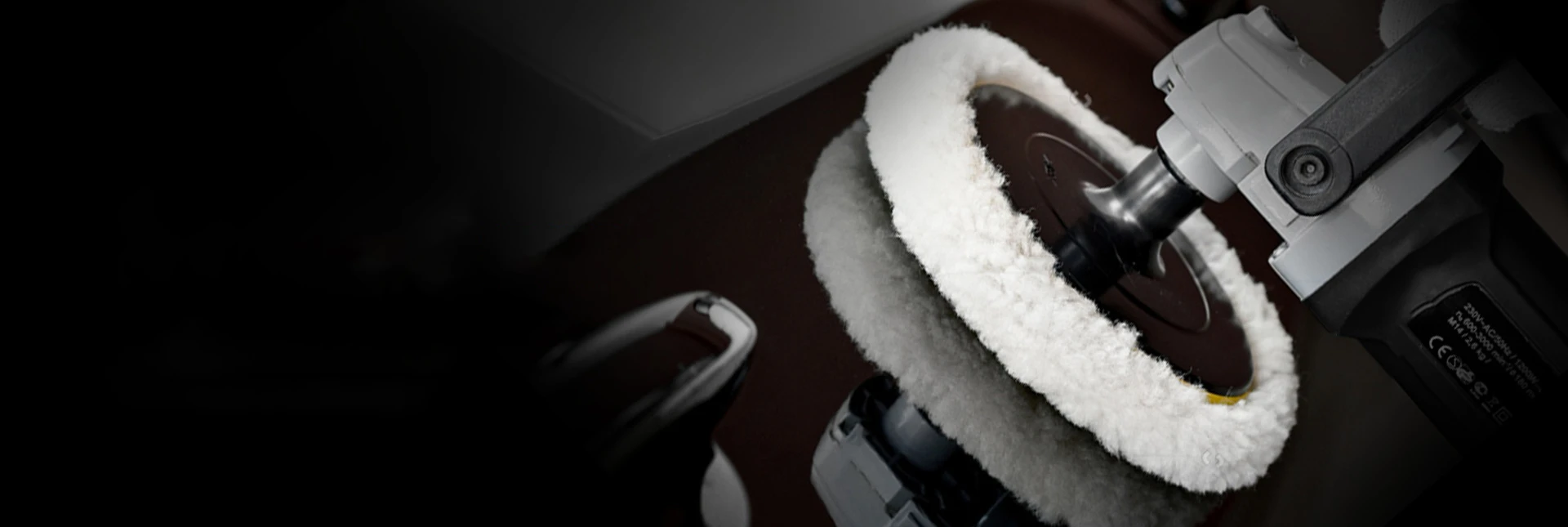
If you run an auto detailing business, you’ve likely encountered this scenario: after completing paint correction on a high-end black vehicle, you spot holograms or swirl marks under the lights. Or worse—your wool pad overheats during high-speed operation, forcing you to stop immediately. These issues often trace back to one seemingly simple decision: the choice of wool polishing pad.
For professional detailing shops, selecting the right wool polishing pad for auto detailing is more than just buying consumables—it directly impacts efficiency, finish quality, and even operational safety. With countless options available, knowing how to choose wool polishing pad that fits your workflow becomes a critical business decision. This guide walks you through the key considerations—pad types, technical parameters, sizes, wool polishing pad durability, maintenance, and sourcing strategies—to help you make informed B2B purchasing decisions.
1. Core Types: Natural Wool Pad vs Synthetic Blend
Wool polishing pads for auto detailing can be categorized by material and function into three main types:
| Type | Characteristics | Best For |
|---|---|---|
| Natural Wool Pad | Strong cutting power, excellent heat dissipation, higher cost | Heavy defect removal, sanding mark elimination, new vehicle paint correction |
| Synthetic Blend Pad | High durability, consistent performance, cost-effective | Daily polishing, standardized workflows, light to medium cutting |
| Composite Wool Pad | Wool + foam construction, balances cutting and cushioning | Versatile use, beginner-friendly, all-in-one solution |
When evaluating natural wool pad vs synthetic, consider your typical workload. Natural wool delivers maximum cutting power for heavy correction, while synthetic blends offer better longevity and batch-to-batch consistency—essential for shops scaling their operations.
2. Key Performance Parameters: Wool Pad Cutting vs Finishing
B2B buyers should look beyond surface appearance. Understanding wool pad cutting vs finishing characteristics helps match products to specific applications.
Fiber Length and Density
- Long fiber / high density: Strong cutting power, requires skilled operation
- Short fiber / medium density: Better finishing results, forgiving for operators
Backing Material and Bonding
- Plastic vs. resin backing: Resin offers better heat resistance and dimensional stability
- Bond strength: Weak bonding leads to delamination—a safety hazard
- Hook-and-loop quality: Ensures secure attachment after repeated use
Heat Dissipation Design
Wool pads generate heat at high speeds. Vented wool polishing pad designs with slots or perforations reduce the risk of burning through clear coat—critical for high-volume commercial use.
3. Sizing: Matching Diameter to Machine and Application
Choosing the right size ensures compatibility with your equipment and coverage for different job types.
| Diameter | Compatible Machine | Typical Application |
|---|---|---|
| 3–4 inches | Mini polisher | Bumpers, headlights, side mirrors, tight areas |
| 5–6 inches | Standard rotary/DA polisher | Doors, hoods, fenders—covers 90% of jobs |
| 7–8 inches | Large rotary polisher | Large flat surfaces, marine, RV |
B2B Sizing Strategy: A combination of 6-inch as the workhorse and 3-inch for details covers the vast majority of detailing scenarios. For shops specializing in heavy paint correction, consider adding best wool pad for rotary polisher options in larger diameters.
4. Durability and ROI Analysis
For B2B buyers, wool polishing pad durability and ROI matter more than unit price. The difference between premium and budget pads goes far beyond upfront cost.
| Factor | Premium Wool Pad | Budget Wool Pad |
|---|---|---|
| Lifespan | 50–100 uses | 10–20 uses |
| Consistency | Stable batch-to-batch | High variability |
| Rework Rate | Low | High |
| Safety Risk | Low | Higher risk of delamination or burning |
True Cost Formula:
(Unit Price ÷ Usable Cycles) + Labor Cost per Failure = True Cost per Use
A premium wool polishing pad for heavy paint correction may cost more upfront, but its lower per-use cost and consistent results translate into higher customer satisfaction and repeat business.
5. Proper Wool Pad Maintenance to Extend Life
Proper care can extend pad life by 30% or more. A consistent wool pad maintenance routine protects your investment:
- Clean immediately after use: Use a pad brush or compressed air to remove residue
- Washing: Use warm water and neutral cleaner; avoid soaking the backing
- Drying: Air dry naturally—never expose to direct sunlight or high heat
- Storage: Store flat without heavy stacking to maintain fiber structure
6. B2B Sourcing: How to Choose a Reliable Wholesale Wool Polishing Pad Manufacturer
When moving to bulk purchasing, selecting the right wholesale wool polishing pad manufacturer becomes as important as product quality.
1. Request Samples
Always test samples in your actual workflow before committing to bulk orders. This is especially critical when sourcing wool polishing pad for car detailing business applications.
2. Evaluate Quality Control
Ask about consistency testing, bond strength verification, and batch-to-batch stability. Reliable manufacturers provide documented quality assurance.
3. Assess Customization Capabilities
If you plan to build your own brand, confirm OEM wool polishing pad capabilities—backing color, logo printing, and custom packaging.
4. Review After-Sales Support
Understand the supplier’s policy on defective batches and response time. Reliable suppliers stand behind their products with clear warranty terms.
7. Conclusion
Choosing the right wool polishing pad is not just about selecting a consumable—it’s an investment in your shop’s efficiency, finish quality, and brand reputation. From matching pad type to application, calculating true cost, and partnering with a reliable wholesale wool polishing pad manufacturer, each step matters.
Whether you need wool polishing pads for auto detailing daily operations or specialized best wool pad for rotary polisher heavy correction, making an informed choice ensures consistent results and satisfied customers.
Ready to upgrade your polishing solutions?
- Request samples to test in your shop
- Contact us for bulk pricing and OEM wool polishing pad customization
- Download our Wool Polishing Pad Selection Quick Reference Sheet
We provide end-to-end wool polishing pad solutions for detailing shops, distributors, and brands—consistent quality, fully customizable.
Appendix: Quick Selection Reference Sheet
Use this quick reference table to identify the right wool polishing pad based on your application, machine type, and desired results.
| Application | Recommended Pad Type | Diameter | Fiber Type | Key Feature |
|---|---|---|---|---|
| Heavy defect removal / Sanding mark elimination | Natural Wool Cutting Pad | 6 inch | Long fiber / natural wool | Maximum cutting power, high heat dissipation |
| Daily polishing / Light to medium correction | Synthetic Blend Polishing Pad | 5–6 inch | Medium fiber / blended | Balanced performance, consistent results |
| Final finishing / Swirl-free mirror shine | Fine Wool Finishing Pad | 6 inch | Short fiber / fine wool | Delivers high-gloss finish, minimal haze |
| Tight areas / Bumpers / Headlights | Mini Wool Pad | 3 inch | Medium fiber | Precision control, access to confined spaces |
| Large flat surfaces / Marine / RV | Large Wool Pad | 7–8 inch | Long or medium fiber | Covers large areas efficiently |
| High-heat / Continuous operation | Vented Wool Pad | 6 inch | Variable | Slotted design reduces heat buildup |