
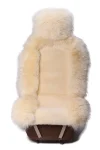

Sit in a car that’s been parked in the sun for two hours. Now sit in one fitted with genuine sheepskin seat covers. The difference isn’t subtle — and it isn’t marketing.
Sheepskin has regulated body temperature for centuries. On a car seat, that same material property becomes a genuine functional advantage: cooler in summer, warmer in winter, and consistently comfortable in between. It’s one of the few automotive accessories that delivers a measurable improvement to the driving experience every single day — not just when it rains, or when you need storage, or when the sun hits the dashboard at a particular angle.
What Genuine Sheepskin Actually Does in a Car
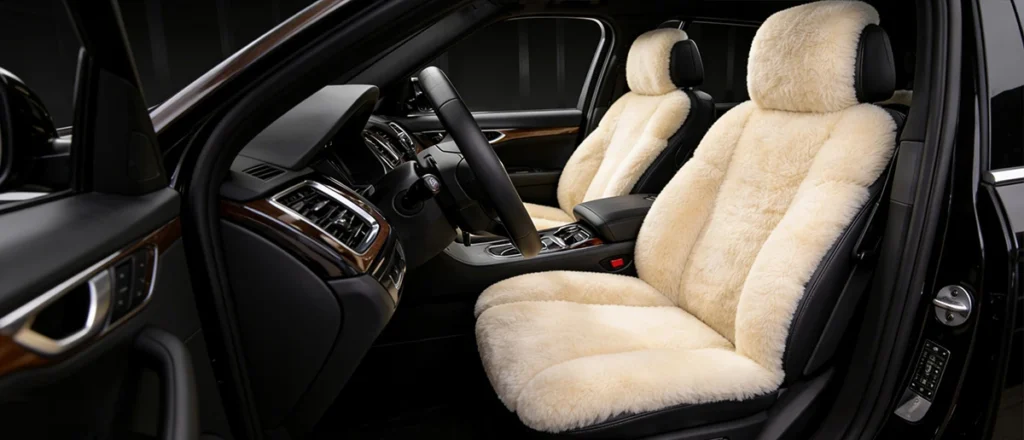
The functional case for sheepskin seat covers begins with the same material science that makes sheepskin valuable in any application: wool fibres are hollow, naturally crimped, and coated in lanolin. In a seat cover context, those properties solve three problems that synthetic materials cannot.
Temperature regulation. A standard car seat — leather, vinyl, or fabric — has no active thermal properties. In summer, it absorbs and retains heat. In winter, it stays cold. Sheepskin’s hollow fibre structure creates a microclimate between the driver and the seat, trapping warm air in cold conditions and wicking moisture and heat away from the body in warm ones. Drivers who spend significant time in their vehicles — long commutes, fleet operators, ride-share drivers — feel this difference on every journey.
Moisture management. Wool fibres can absorb up to 30% of their weight in moisture before they feel damp to the touch. On a seat cover, this means perspiration is drawn away from clothing and skin during extended driving, rather than building up at the contact point. The practical result is a more comfortable seat at the end of a long journey than at the beginning — an unusual claim for any automotive accessory.
Surface protection. A sheepskin seat cover protects the original upholstery underneath — from UV degradation, friction wear, and staining.
Genuine Sheepskin vs Synthetic Alternatives
The sheepskin seat cover market contains a significant volume of synthetic products — faux sheepskin, polyester pile, blended materials — that trade on the category name without delivering its properties. The comparison matters for buyers who need to justify a higher unit cost to their customers.
| Genuine Sheepskin | Faux Sheepskin / Synthetic | |
|---|---|---|
| Temperature regulation | Active — wicks and insulates | None — traps heat and moisture |
| Moisture management | Absorbs up to 30% of weight | Holds moisture against skin |
| Durability | 5–10+ years with care | 1–3 years typical |
| Softness over time | Improves with use | Flattens and matts |
| Hypoallergenic | Yes — natural lanolin | No — can harbour static and dust |
| Washable | Yes — wool cycle, air dry | Limited — degrades quickly |
| Environmental impact | Biodegradable | Petroleum-based |
What to Look for When Sourcing
The sheepskin seat cover supply chain contains significant variation in quality that is not always visible in product images or reflected in minimum order pricing. These are the criteria that matter.
Hide quality and origin. Australian or New Zealand Merino origin should be documentable. Ask for a certificate of origin, not just a country label. The quality difference between Merino and commodity sheepskin is significant — in softness, durability, and the way the product ages with use.
Tanning method. Chrome-free or aldehyde-free tanning is the appropriate standard for products in prolonged skin contact. Ask suppliers to confirm their tanning process in writing. A supplier who cannot specify their tanning method is not in control of their supply chain.
Wool density and pile depth. Press your hand into the cover. The pile should feel dense and spring back fully. Thin or uneven pile — particularly at seam edges and high-wear contact points — indicates lower-grade hide or inconsistent manufacturing.
Backing and attachment construction. The elastic backing, straps, and hooks must hold position under daily use without causing seat wear or slipping during driving. Test under realistic conditions — including simulated entry and exit movement — before committing to volume.
Wash durability. Sheepskin seat covers will be washed. Request samples and run three wash cycles on a wool setting before evaluating. The cover should maintain its shape, pile density, and colour. Significant shrinkage or matting after washing is a quality failure that will generate customer complaints.
Seat function compatibility. Covers must accommodate heated seats, side airbags integrated into seat bolsters, and seatbelt anchor points without obstruction. This is a safety and liability issue, not just a fitment preference. Confirm compatibility specifications before supplying to dealer channels.
A Product That Justifies Itself Every Day
Most automotive accessories are used occasionally — when it rains, when extra storage is needed, when a specific function is required. A sheepskin seat cover is used every time the vehicle is driven. That daily-use frequency is rare in the category, and it shapes everything about how the product performs as a retail proposition.
A driver who notices the difference on the first warm day after fitting the covers has already justified the purchase to themselves. A driver who is still noticing it three years later — because the pile hasn’t matted, the colour hasn’t faded, and the cover hasn’t slipped — is a customer who tells other people.
That’s not a marketing outcome. That’s what happens when the material is right.
Explore our range of 100% genuine sheepskin seat covers — Australian and New Zealand Merino, universal and custom fit, available in multiple colours →
Wholesale pricing available · Private label options · Sample packs for trade buyers