


Dust doesn’t disappear when you move it. With most cleaning tools, it lifts briefly and settles somewhere else — on a nearby surface, into the air, back onto the floor. Professional cleaning operations know this problem well. It’s why the best housekeeping teams stopped using synthetic dusters decades ago and never went back.
A lambswool duster works differently. The fibres don’t push dust around. They hold it.
What Makes Lambswool Different From Every Other Duster Material
The performance of a lambswool duster comes down to two properties that no synthetic fibre can replicate: natural crimp and lanolin.
Wool fibres are not smooth. Under magnification, each fibre is covered in microscopic scales and has a natural three-dimensional crimp — a helical curl that gives wool its loft and resilience. When a lambswool duster moves across a surface, those scales and crimps physically trap dust particles rather than deflecting them. The dust goes in and stays in until the duster is shaken out or washed.
Lanolin — the natural wax present in all genuine wool — adds an electrostatic dimension. Lambswool carries a mild natural charge that attracts fine dust, pet dander, and particulates the way a magnet attracts metal filings. This is particularly effective on electronics, delicate surfaces, and the kind of fine dust that accumulates in hospitality environments: on lamp shades, artwork, mouldings, and display surfaces where a damp cloth would cause damage.
The result is a duster that captures dust rather than redistributing it. In environments where air quality and cleanliness standards matter — hotels, healthcare-adjacent spaces, automotive showrooms — that difference is measurable.
The Case for Natural Over Synthetic
Synthetic dusters — microfibre, polyester, electrostatic disposables — dominate the lower end of the market for one reason: they are cheap to produce. They also share a consistent set of limitations that become significant at professional scale.
Synthetic fibres flatten with use. The electrostatic charge that makes a new synthetic duster functional dissipates after the first few wash cycles, and the fibres themselves compress and lose their dust-trapping structure. Most synthetic dusters perform acceptably for a few weeks and decline steadily from there.
Lambswool does the opposite. The natural crimp structure of wool is mechanically resilient — it returns to shape after compression, maintains its dust-trapping geometry through repeated use, and the lanolin content replenishes partially with each wash using a wool-appropriate shampoo. A well-maintained lambswool duster used in a professional setting outperforms its day-one performance for months and holds its function for years.
For operations calculating cost-per-use rather than cost-per-unit, the economics of lambswool are not close.
| Lambswool Duster | Microfibre Duster | Synthetic Electrostatic | |
|---|---|---|---|
| Dust capture method | Mechanical + natural lanolin charge | Mechanical (when new) | Electrostatic (degrades) |
| Performance over time | Stable to improving | Degrades with washing | Degrades quickly |
| Washable | Yes — repeatedly | Yes, limited cycles | Usually no |
| Lifespan | 3–5+ years with care | 6–18 months | Weeks to months |
| Surface compatibility | All surfaces including delicate | Moderate — can scratch | Limited |
| Environmental impact | Biodegradable | Non-biodegradable | Non-biodegradable |
Size and Configuration: Matching the Tool to the Job
A single duster size does not serve a professional cleaning operation. Different environments and tasks require different reach, head size, and manoeuvrability.
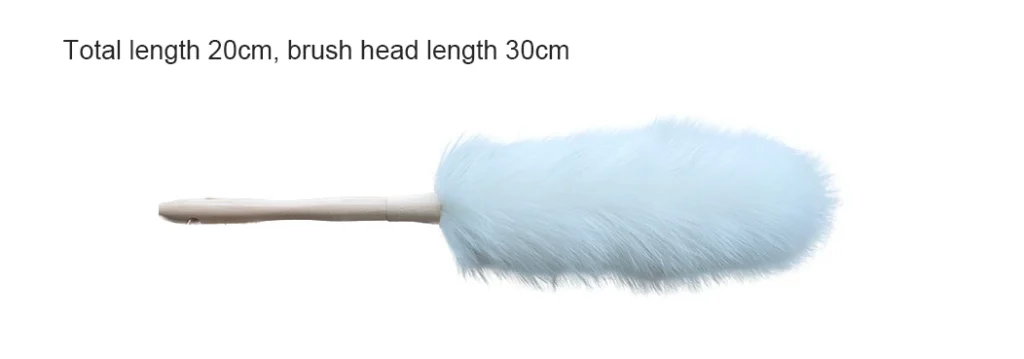
Short handle dusters (20–30 cm) are the standard choice for close-range work: countertops, shelving, display cases, vehicle interiors, and electronics. The shorter handle provides control and precision where reach isn’t the priority.
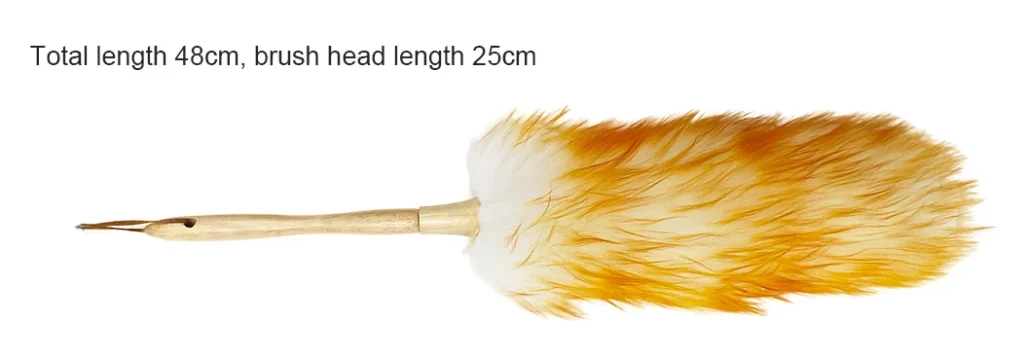
Medium handle dusters (40–60 cm) are the workhorse of hotel housekeeping — suited to furniture, headboards, wardrobes, artwork, and the majority of room cleaning tasks. The length provides reach without sacrificing control.
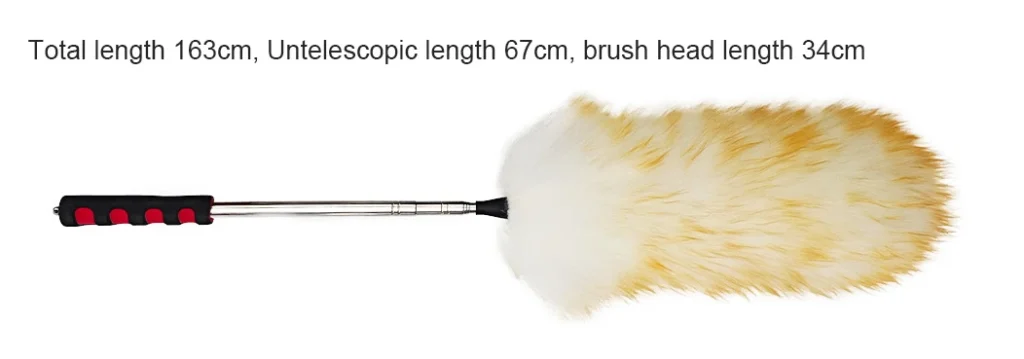
Telescopic dusters extend the tool’s range from a standard handle length to 120 cm or more, making them essential for high surfaces: crown moulding, ceiling fans, tops of wardrobes, high shelving in commercial spaces, and the upper surfaces of vehicles in detailing environments. The best telescopic designs allow single-handed extension and locking — important when the other hand is steadying a ladder or holding a surface.
Automotive detailing dusters are typically shorter with a denser, more compact head — designed for vehicle panels, dashboards, and instrument clusters where a large head would be impractical and where the risk of surface scratching demands the finest possible fibres.
For buyers stocking a cleaning supply range, offering at least three size configurations is the minimum for serving professional customers properly. A single-size lambswool duster offering tells experienced cleaning managers that the range wasn’t built with their workflow in mind.
What to Look for When Sourcing
The lambswool duster market contains a significant volume of product described as “lambswool” that contains blended, synthetic, or low-grade wool. These are the criteria that separate genuine quality from marketing language.
Wool content declaration. 100% lambswool means no synthetic blend. Ask suppliers to confirm in writing. Products labelled “lambswool-style” or “wool blend” are not lambswool dusters.
Fibre origin documentation. Australian or New Zealand Merino origin should be documentable, not just claimed. A supplier who cannot provide origin paperwork is sourcing commodity wool.
Head density. Hold the duster head and compress it. It should feel dense, spring back fully, and show consistent fibre distribution with no thin patches. Sparse or uneven heads produce inconsistent cleaning results and shed more during use.
Shedding test. Run the duster across a dark surface before committing to volume. Minimal loose fibres is the standard. Significant shedding on a new duster indicates poor construction — loose fibres bound into the head rather than properly attached.
Handle construction. For telescopic models, the locking mechanism should hold firm under lateral pressure during use. Handles that slip mid-stroke are a usability problem that generates complaints regardless of wool quality.
Wash durability. Request wash testing data or test samples yourself — three full wash cycles with a wool shampoo, air dried. The head should maintain its density and shape. Significant shrinkage, matting, or fibre loss after washing indicates inadequate construction for professional use.
Care and Maintenance at Professional Scale
A lambswool duster maintained correctly at professional scale delivers years of consistent performance. The maintenance protocol is straightforward.
After each use: Shake the duster firmly — holding the handle between both palms and rolling it rapidly works well for distributing the motion evenly — to release captured dust. Do this outdoors or over a waste receptacle, not over the surface just cleaned.
Weekly (heavy use) or monthly (moderate use): Wash in cool water (maximum 30°C) with a wool-safe shampoo. Gently squeeze — never wring or twist the head. Reshape and air dry away from direct heat. Once dry, the head can be gently fluffed with a soft brush to restore loft.
What to avoid: Hot water, enzyme-based detergents, tumble drying, and storing compressed. Each degrades the wool structure in ways that cannot be reversed.
For operations managing large duster inventories, a simple wash rotation — cycling dusters through washing on a defined schedule rather than waiting for visible soiling — keeps the entire fleet performing at specification.
Explore our range of 100% Australian and New Zealand Merino lambswool dusters — available in multiple sizes with telescopic handle options →
Wholesale pricing available · Sample packs for trade buyers · Washable and reusable