
Ask any professional detailer which pad they reach for when a car comes in with deep oxidation, heavy swirl marks, or paint that’s been color-sanded — and the answer is almost always wool. Not because it’s traditional. Because it works faster than anything else at the correction stage, and when the wool is right, it works without damaging the surface underneath.
That distinction — when the wool is right — is where most sourcing decisions go wrong.
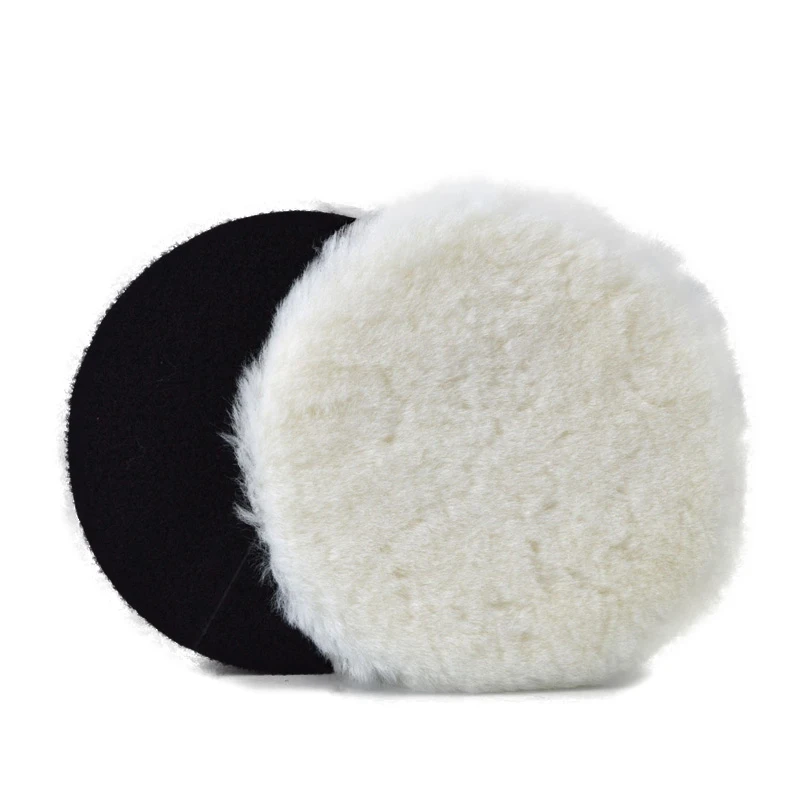
What a Wool Polishing Pad Actually Does
A wool polishing pad is a cutting tool. Its job is paint correction — removing oxidation, scratches, sanding marks, and surface defects more aggressively and efficiently than foam or microfiber alternatives.
The reason wool outperforms foam at this stage comes down to fibre mechanics. Wool fibres are naturally crimped — they have a three-dimensional curl that gives them mechanical resilience under pressure. When a wool pad is pressed against a paint surface at rotary or DA polisher speeds, those fibres flex, grip the surface, and cut. Foam compresses and slides. Wool works.
The result is measurably faster correction. A skilled detailer can remove a defect with a wool pad in a fraction of the time it would take with even an aggressive foam cutting pad. In a professional shop where time is money, that efficiency difference compounds across every job.
There’s a second benefit that surprises people: wool runs cooler than foam under sustained use. The open, fibrous structure of a wool pad allows heat to dissipate as it works, rather than building up at the pad-paint interface. For professionals working on temperature-sensitive finishes — modern single-stage paints, matte coatings, delicate clear coats — this matters more than cutting speed.
Long wool vs Short wool: The Decision That Defines the Application
Not all wool polishing pad are built the same, and the single most important variable is pile length.
Long wool pads carry more compound, cut more aggressively, and generate more heat during use. They excel at heavy correction work — removing deep scratches, severe oxidation, and orange peel on robust paint systems. The trade-off is that long pile pads require more experience to control and are less forgiving on lighter or thinner paints.
Short wool pads offer more contact between fibre and surface, which increases correction precision and reduces heat generation. They perform well in the intermediate correction stage — after heavy cutting, before moving to foam for finishing — and are better suited to paint systems where heat management is critical.
Wool Polishing Pad vs Foam Pad
The wool vs. foam conversation is one of the most persistent in professional detailing, and it’s usually framed as a competition. It isn’t. They do different jobs.
| Wool Polishing Pad | Foam Cutting Pad | Foam Finishing Pad | |
|---|---|---|---|
| Primary use | Heavy correction, compounding | Medium correction | Finishing, wax/sealant application |
| Cutting speed | Fast | Moderate | Minimal |
| Heat generation | Lower than foam (at equivalent speed) | Moderate to high | Low |
| Compound carry | High | Moderate | Low |
| Finishing quality | Requires follow-up step | Moderate haze | High gloss |
| Durability | High — if washed correctly | Moderate | Lower |
| Skill level required | Intermediate to professional | Beginner to intermediate | Beginner |
The practical workflow in a professional correction detail is: wool pad for compounding → foam polishing pad to refine → foam finishing pad for final gloss. Each stage serves a purpose. Wool is the one that does the heavy work at the beginning — and the one that determines how much work the subsequent stages need to do.
For buyers stocking a detailing supply range, this means wool pads are not a standalone category. They’re the entry point to a system. The retailer who stocks wool pads alongside the right foam follow-up pads — and communicates the system to their customers — sells more than the one who stocks wool pads alone.
The Industrial and Non-Automotive Market
Paint correction is the primary market for wool polishing pads, but it’s not the only one. The same material properties — fast cutting, controlled heat, natural fibre resilience — make wool pads effective across a range of surface finishing applications.
Furniture and cabinetry finishing operations use wool pads for lacquer and varnish correction. Marine refinishers use them on gelcoat. Stone and solid surface fabricators use them for initial polishing of countertops and panels. Epoxy floor coating applicators use them for early-stage surface preparation.
For a supplier or distributor already in the automotive detailing space, these adjacent markets represent incremental volume from existing inventory. The product doesn’t change. The customer segment and the messaging do.
Why 100% Pure Wool Outperforms Blended Alternatives
The market contains wool polishing pads made from blended materials — wool combined with synthetic fibres, or synthetic fibres marketed with wool-adjacent language. The performance difference is consistent and measurable.
Pure wool maintains its crimp structure and cutting profile through repeated compression and washing. Synthetic fibres flatten. The result is a blended pad that performs acceptably when new and degrades faster with use — which is exactly the opposite of what a professional detailer buying for a working shop needs.
100% wool, sourced properly and manufactured correctly, is the product that generates repeat orders. It’s also the product that builds supplier reputation in a market where word-of-mouth between professional shops is one of the most powerful distribution channels available.
Explore our range of 100% Merino wool polishing pads — available in long and short pile, multiple sizes, and hook-and-loop or threaded backing →
Wholesale pricing available · Sample packs for trade buyers · Australian and New Zealand wool, documented